
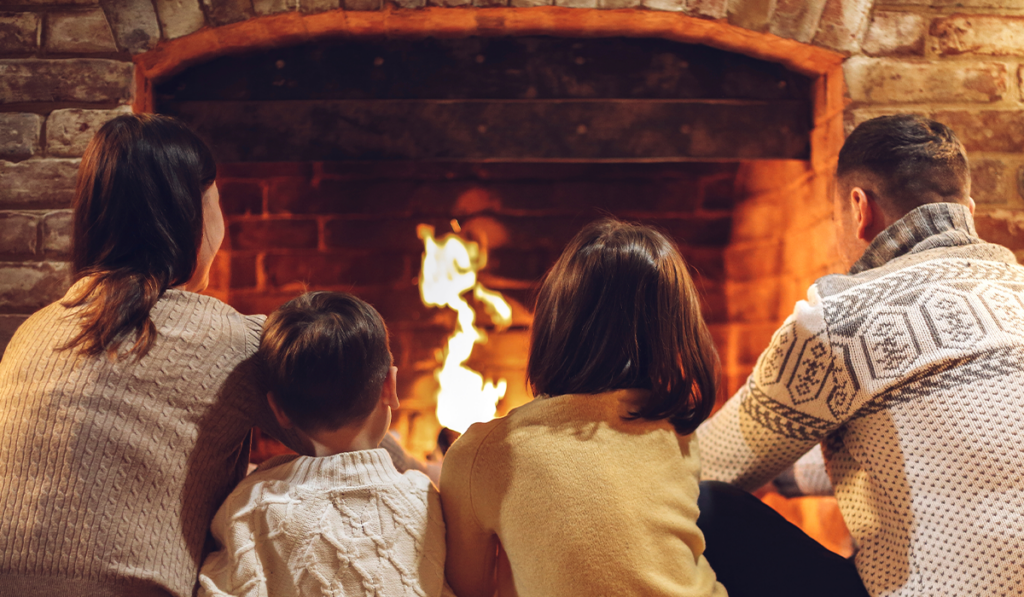
Gathering around a fire, whether it is a bonfire outdoors or an electric fire on date night, is a way to bring people together. Don’t trust our word for it – there is physiological and evolutionary evidence for this phenomenon, and in this article we deep dive into the principles and theories that have developed from socializing by a fire.
Campfire Principle
Charles Vogl, an international author who specializes in community, posits that the Campfire Principle states that campfires nurture relationships and intimate conversations because, “At campfires, we have time, proximity, freedom, and intimacy to connect meaningfully with others if we choose.” He even goes as far to say that even in larger groups, with a campfire, you can achieve a level of intimacy that connects individuals with one another by sharing moments of vulnerability with each other. The act of gathering around a fire dates back to our evolutionary history, and anthropologists claim that the central role of a fire encouraged communication (sharing stories) and reinforced social bonding. This long-standing tradition of storytelling over the fire, connects us to one another, making us feel less lonely and more a part of a community.
Fireside Relaxation Study
The sensory details of a fire also create positive physical and mental responses including, easing anxiety, lowering blood pressure, and contributing to mindfulness, according to the Fireside Relaxation Study by the University of Alabama. Professor Chris Lynn concludes, “Findings confirm that hearth and campfires induce relaxation as part of a multisensory, absorptive, and social experience.” The flicker of the flames and the crackling sounds of the fire burning, transports you right to the present moment – forcing you to disconnect from technology and the anxiety and worries that come with our present-day lives. By giving in to ‘being present’, you gain mindfulness, a meditative state that’s achieved by focusing one’s awareness on the present moment. The warmth of the fire also allows you to relax tense muscles, and is actually linked to a better night’s sleep, another advantage of gathering by the fire.
The “Third Place” Theory
The “Third Place” effect was introduced by sociologist Ray Oldenburg, arguing that people need a “Third Place” where they can gather, interact informally, and build community – a separate space than home and work (the “first place” and “second place”, respectively). Gathering around a fire served as a powerful “Third Place”. Today, however, there’s a shift where the “first place” (home) merges with the “third place”. Due to rising living costs, overcrowding, shorter hours for free time, and social burnout, the home is now the primary gathering place. This makes gathering around a fire, or traditional and electric fireplaces, even more important. The fireplace provides ambient, soft lighting that encourages even the most introverted among us to open up. Sharing personal experiences fosters meaningful conversation, which builds trust and relationships. This feeling of belonging resonates not only today, but also, again, with our evolutionary roots.
Conclusion
Whether you are gathering for your next outdoor bonfire or having wine on date night by your electric fireplace, cozy up to you loved ones and receive the effects of the the crackling flames and warm hues that your fire emits that our ancestors have been doing for thousands of years.
References:
https://www.charlesvogl.com/articles/the-campfire-principle-for-community
https://sites.ua.edu/cdlynn/firesiderelaxationstudy/
https://journals.sagepub.com/doi/full/10.1177/147470491401200509